
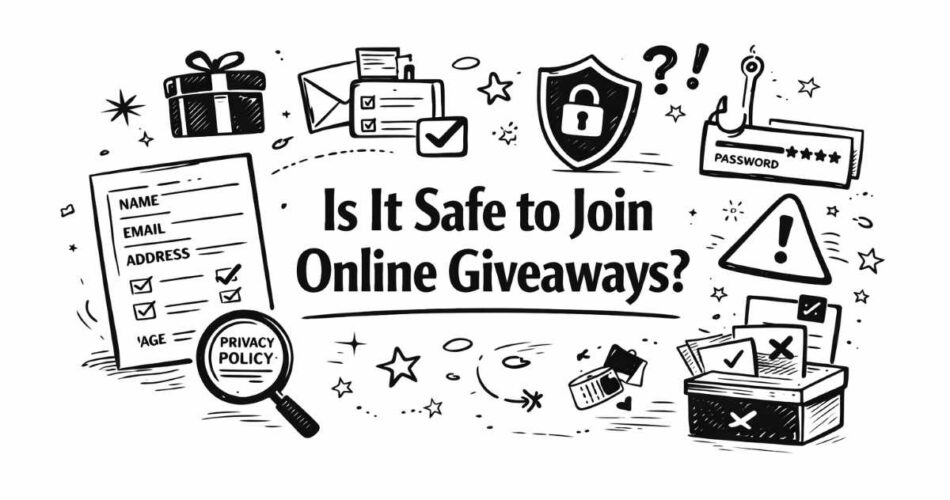
Online giveaways are designed to feel easy and harmless. A few clicks, a short form, maybe a follow or a comment and suddenly you are “in”. But behind that simplicity, many people quietly wonder the same thing: Is this actually safe?
The short answer is that joining online giveaways can be safe, but only if you understand what information is being collected, how it is used, and when to walk away. This guide explains the real privacy risks involved, how reputable brands handle participant data, and how you can join giveaways without putting yourself at unnecessary risk.
Data Commonly Requested in Giveaways
Most legitimate giveaways ask for a limited set of information. This data is usually tied to prize delivery, winner verification, or basic marketing goals.
Commonly requested data includes:
- Email address
- Social media username
- Name or display name
- Country or region
- Confirmation of age eligibility
In some cases, giveaways may ask for:
- Mailing address (for physical prizes)
- Phone number (less common, but sometimes used for delivery updates)
- Answers to simple survey questions
On their own, these data points are not inherently dangerous. Problems arise when too much data is requested too early, or when the request has no clear connection to the giveaway itself.
Privacy Risks Explained
The main privacy risk in online giveaways is not winning or losing it is data misuse.
Some giveaways are created primarily to collect email addresses for marketing. While this is not illegal or unsafe by default, it can lead to increased spam if data is shared or sold to third parties.
More serious risks appear when giveaways ask for:
- Login credentials or verification codes
- Payment details or “processing fees”
- Government-issued identification without justification
- Sensitive personal information unrelated to prize delivery
Another risk is data leakage. Even well-intentioned organizers may use insecure tools or platforms, which can expose participant data through breaches or misconfigurations.
Understanding these risks does not mean avoiding all giveaways it means recognizing where caution is necessary.
How Reputable Brands Handle Participant Data
Reputable brands treat giveaway data as a responsibility, not a shortcut.
They usually follow a few consistent practices:
- Clearly stating what data is collected and why
- Limiting data requests to what is actually needed
- Using secure forms or trusted third-party tools
- Including privacy policy links alongside the giveaway
- Not requesting sensitive data until after a winner is confirmed
For example, a legitimate giveaway rarely asks for a full mailing address before a winner is selected. That information is typically requested only after confirmation.
Transparency is the strongest indicator of safety. When a brand explains its process openly, it reduces uncertainty for participants.
Safe Participation Practices
You can significantly reduce risk by adopting a few simple habits.
First, use a dedicated email address for giveaways. This keeps your primary inbox clean and limits exposure if your email is added to mailing lists.
Second, avoid oversharing. If a giveaway asks for information that feels excessive, pause and reassess. You are never obligated to complete an entry.
Third, verify the source. Check whether the giveaway is hosted on an official website or verified social account. When in doubt, visit the brand’s site manually instead of clicking links.
Fourth, read the privacy policy or at least skim it. Look for how data is stored, used, and shared.
Finally, trust your instincts. If a giveaway feels rushed, unclear, or uncomfortable, skipping it costs you nothing.
When to Avoid a Giveaway
Some giveaways should be avoided entirely, regardless of how attractive the prize looks.
Avoid giveaways that:
- Ask for payment to enter or claim a prize
- Request passwords, private keys, or verification codes
- Use extreme urgency or threats (“act now or lose your prize”)
- Cannot clearly identify the organizer
- Redirect you to unfamiliar or suspicious websites
Legitimate giveaways do not pressure participants or blur boundaries around personal data.
Balancing Opportunity and Caution
It is easy to view giveaways as either completely safe or completely dangerous. In reality, they sit somewhere in between.
Most legitimate giveaways are low-risk when joined thoughtfully. The danger comes from automatic participation without awareness. By slowing down and evaluating what is being asked, you regain control over the experience.
Safety is not about fear it is about informed choices.
Final Reminder
Joining online giveaways can be safe, enjoyable, and occasionally rewarding but only when you stay mindful of your data.
You should always know:
- Who is running the giveaway
- What information you are sharing
- Why it is being requested
- What happens if you do not win
When those answers are clear, participation is usually safe. When they are not, walking away is the smartest choice you can make.

